Off the Top: Information Application Development Entries

20052010201520202025

Showing posts: 16-30 of 195 total posts


25 January 2009

Optimizing Tagging UI for People & Search

Overview/Intro

One of my areas of focus is around social tools in the workplace (enterprise 2.0) is social bookmarking. Sadly, is does not have the reach it should as it and wiki (most enterprise focused wikis have collective voice pages (blogs) included now & enterprise blog tools have collaborative document pages (wikis). I focus a lot of my attention these days on what happens inside the organization’s firewall, as that is where their is incredible untapped potential for these tools to make a huge difference.

One of the things I see on a regular basis is tagging interfaces on a wide variety of social tools, not just in social bookmarking. This is good, but also problematic as it leads to a need for a central tagging repository (more on this in a later piece). It is good as emergent and connective tag terms can be used to link items across tools and services, but that requires consistency and identity (identity is a must for tagging on any platform and it is left out of many tagging instances. This greatly decreases the value of tagging - this is also for another piece). There are differences across tools and services, which leads to problems of use and adoption within tools is tagging user interface (UI).

Multi-term Tag Intro
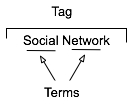
multiterm tag constructionThe multi-term tag is one of the more helpful elements in tagging as it provides the capability to use related terms. These multi-term tags provide depth to understanding when keeping the related tag terms together. But the interfaces for doing this are more complex and confusing than they should be for human, as well as machine consumption.

In the instance illustrated to the tag is comprised or two related terms: social and network. When the tool references the tag, it is looking at both parts as a tag set, which has a distinct meaning. The individual terms can be easily used for searches seeking either of those terms, but knowing the composition of the set, it is relatively easy for the service to offer up "social network" when a person seeks just social or network in a search query.

One common hindrance with social bookmarking adoption is those familiar with it and fans of it for enterprise use point to Delicious, which has a couple huge drawbacks. The compound multi-term tag or disconnected multi-term tags is a deep drawback for most regular potential users (the second is lack of privacy for shared group items). Delicious breaks a basic construct in user focussed design: Tools should embrace human methods of interaction and not humans embracing tech constraints. Delicious is quite popular with those of us malleable in our approach to adopt a technology where we adapt our approach, but that percentage of potential people using the tools is quite thin as a percentage of the population.. Testing this concept takes very little time to prove.

So, what are the options? Glad you asked. But, first a quick additional excursion into why this matters.

Conceptual Models Missing in Social Tool Adoption

One common hinderance for social tool adoption is most people intended to use the tools are missing the conceptual model for what these tools do, the value they offer, and how to personally benefit from these values. There are even change costs involved in moving from a tool that may not work for someone to something that has potential for drastically improved value. The "what it does", "what value it has", and "what situations" are high enough hurdles to cross, but they can be done with some ease by people who have deep knowledge of how to bridge these conceptual model gaps.

What the tools must not do is increase hurdles for adoption by introducing foreign conceptual models into the understanding process. The Delicious model of multi-term tagging adds a very large conceptual barrier for many & it become problematic for even considering adoption. Optimally, Delicious should not be used alone as a means to introduce social bookmarking or tagging.

We must remove the barriers to entry to these powerful offerings as much as we can as designers and developers. We know the value, we know the future, but we need to extend this. It must be done now, as later is too late and these tools will be written off as just as complex and cumbersome as their predecessors.

If you are a buyer of these tools and services, this is you guideline for the minimum of what you should accept. There is much you should not accept. On this front, you need to push back. It is your money you are spending on the products, implementation, and people helping encourage adoption. Not pushing back on what is not acceptable will greatly hinder adoption and increase the costs for more people to ease the change and adoption processes. Both of these costs should not be acceptable to you.

Multi-term Tag UI Options

Compound Terms

I am starting with what we know to be problematic for broad adoption for input. But, compound terms also create problems for search as well as click retrieval. There are two UI interaction patterns that happen with compound multi-term tags. The first is the terms are mashed together as a compound single word, as shown in this example from Delicious.

Tag sample from Delicious

The problem here is the mashing the string of terms "architecture is politics" into one compound term "architectureispolitics". Outside of Germanic languages this is problematic and the compound term makes a quick scan of the terms by a person far more difficult. But it also complicates search as the terms need to be broken down to even have LIKE SQL search options work optimally. The biggest problem is for humans, as this is not natural in most language contexts. A look at misunderstood URLs makes the point easier to understand (Top Ten Worst URLs)

The second is an emergent model for compound multi-term tags is using a term delimiter. These delimiters are often underlines ( _ ), dots ( . ), or hyphens ( - ). A multi-term tag such as "enterprise search" becomes "enterprise.search", "enterprise_search" and "enterprise-search".

While these help visually they are less than optimal for reading. But, algorithmically this initially looks to be a simple solution, but it becomes more problematic. Some tools and services try to normalize the terms to identify similar and relevant items, which requires a little bit of work. The terms can be separated at their delimiters and used as properly separated terms, but since the systems are compound term centric more often than not the terms are compressed and have similar problems to the other approach.

Another reason this is problematic is term delimiters can often have semantic relevance for tribal differentiation. This first surface terms when talking to social computing researchers using Delicious a few years ago. They pointed out that social.network, social_network, and social-network had quite different communities using the tags and often did not agree on underlying foundations for what the term meant. The people in the various communities self identified and stuck to their tribes use of the term differentiated by delimiter.

The discovery that these variations were not fungible was an eye opener and quickly had me looking at other similar situations. I found this was not a one-off situation, but one with a fair amount of occurrence. When removing the delimiters between the terms the technologies removed the capability of understanding human variance and tribes. This method also breaks recommendation systems badly as well as hindering the capability of augmenting serendipity.

So how do these tribes identify without these markers? Often they use additional tags to identity. The social computing researchers add "social computing", marketing types add "marketing", etc. The tools then use their filtering by co-occurrence of tags to surface relevant information (yes, the ability to use co-occurrence is another tool essential). This additional tag addition help improve the service on the whole with disambiguation.

Disconnected Multi-term Tags

The use of distinct and disconnected term tags is often the intent for space delimited sites like Delicious, but the emergent approach of mashing terms together out of need surfaced. Delicious did not intend to create mashed terms or delimited terms, Joshua Schachter created a great tool and the community adapted it to their needs. Tagging services are not new, as they have been around for more than two decades already, but how they are built, used, and platforms are quite different now. The common web interface for tagging has been single terms as tags with many tags applied to an object. What made folksonomy different from previous tagging was the inclusion of identity and a collective (not collaborative) voice that intelligent semantics can be applied to.

The downside of disconnected terms in tagging is certainty of relevance between the terms, which leads to ambiguity. This discussion has been going on for more than a decade and builds upon semantic understanding in natural language processing. Did the tagger intend for a relationship between social & network or not. Tags out of the context of natural language constructs provide difficulties without some other construct for sense making around them. Additionally, the computational power needed to parse and pair potential relevant pairings is somethings that becomes prohibitive at scale.

Quoted Multi-term Tags

One of the methods that surfaced early in tagging interfaces was the quoted multi-term tags. This takes becomes #&039;research "social network" blog' so that the terms social network are bound together in the tool as one tag. The biggest problem is still on the human input side of things as this is yet again not a natural language construct. Systematically the downside is these break along single terms with quotes in many of the systems that have employed this method.

What begins with a simple helpful prompt...:

 SlideShare Tag Input UI

Still often can end up breaking as follows (from SlideShare):

SlideShare quoted multi-term tag parsing

Comma Delimited Tags

Non-space delimiters between tags allows for multi-term tags to exist and with relative ease. Well, that is relative ease for those writing Western European languages that commonly use commas as a string separator. This method allows the system to grasp there are multi-term tags and the humans can input the information in a format that may be natural for them. Using natural language constructs helps provide the ability ease of adoption. It also helps provide a solid base for building a synonym repository in and/or around the tagging tools.

Ma.gnolia comma separated multi-term tag output

While this is not optimal for all people because of variance in language constructs globally, it is a method that works well for a quasi-homogeneous population of people tagging. This also takes out much of the ambiguity computationally for information retrieval, which lowers computational resources needed for discernment.

Text Box Per Tag

Lastly, the option for input is the text box per tag. This allows for multi-term tags in one text box. Using the tab button on the keyboard after entering a tag the person using this interface will jump down to the next empty text box and have the ability to input a term. I first started seeing this a few years ago in tagging interfaces tools developed in Central Europe and Asia. The Yahoo! Bookmarks 2 UI adopted this in a slightly different implementation than I had seen before, but works much the same (it is shown here).
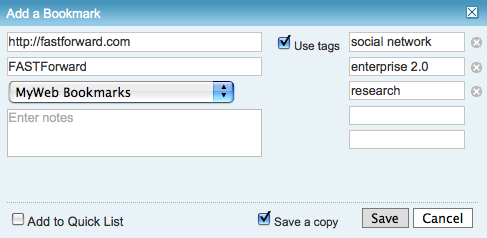
Yahoo! Bookmarks 2 text box per tag

There are many variations of this type of interface surfacing and are having rather good adoption rates with people unfamiliar to tagging. This approach tied to facets has been deployed in Knowledge Plaza by Whatever s/a and works wonderfully.

All of the benefits of comma delimited multi-term tag interfaces apply, but with the added benefit of having this interface work internationally. International usage not only helps build synonym resources but eases language translation as well, which is particularly helpful for capturing international variance on business or emergent terms.

Summary

This content has come from more than four years of research and discussions with people using tools, both inside enterprise and using consumer web tools. As enterprise moves more quickly toward more cost effective tools for capturing and connecting information, they are aware of not only the value of social tools, but tools that get out the way and allow humans to capture, share, and interact in a manner that is as natural as possible with the tools getting smart, not humans having to adopt technology patterns.

This is a syndicated version of the same post at Optimizing Tagging UI for People & Search :: Personal InfoCloud that has moderated comments available.

28 August 2008

Tale of Two Tunnels: Web 2.0 and Enterprise 2.0

Yesterday I made a few comments in Twitter that prompted a fair amount of questions and requests for more information. The quips I made were about the differences between Web 2.0 (yes, an ambiguous term) and Enterprise 2.0 (equally ambiguous term both for the definition of enterprise and the 2.0 bit). My comments were in response to Bruce Stewart's comment The whole "Enterprise 2.0" schtick is wearing thin, unless you've been monitoring real results. Otherwise you're just pumping technology.. In part I agree, but I am really seeing things still are really early in the emergence cycle and there is still much need for understanding of the social tools and the need for them, as well as how they fit in. There are many that are selling the tools as technologies with great promise. We have seen the magic pill continually pitched and bought through out the history of business tools. (For those new to the game or only been paying attention for the last 15 years, a huge hint, THERE IS NO MAGIC PILL).

Tale of 2 Tunnels

One comment I made yesterday is, "the difference between Web 2.0 and Enterprise 2.0 is like the difference building a tunnel through rock and tunnel under water".

That this is getting at is Web 2.0 takes work to build to get through the earth, but once built it can suffer from imperfections and still work well. The tunnel can crack and crumble a little, but still get used with diminished capacity. We can look at Facebook, which has a rather poor interface and still gets used. Twitter is another example of a Web 2.0 solution that has its structural deficiencies and outages, but it still used as well as still loved (their Fail Whale is on a t-shirt now and a badge of pride worn by loyal users).

The Enterprise 2.0 tunnel is built under water. This takes more engineering understanding, but it also requires more fault testing and assurances. A crack or crumbling of a tool inside an organization is not seen kindly and raises doubts around the viability of the tool. The shear volume of users inside an organization using these tools is orders of magnitude less than in the open consumer web world, but faults are more deadly.

The other important factor is perceived fear of the environment. Fewer people (by pure numbers - as the percentages are likely the same, more on this later) are fearful of tunnels through land, they may not have full faith in them, but they know that they will likely make it safely on all of their journeys. The tunnels under water have greater fears as one little crack can cause flooding and drowning quickly. Fears of use of social tools inside an organization is often quite similar, there may be many that are not fearful, but if you spend time talking to people in organizations not using tools (it is the majority at this point) they are fearful of open sharing as that could lead to trouble. People are not comfortable with the concept as they are foreign to it as they are lacking the conceptual models to let them think through it.

Enterprise 2.0 is not Web 2.0

Another statement yesterday that garnered a lot of feedback was, "Web 2.0 does not work well in enterprise, but the approaches and understandings of Web 2.0 modified for enterprise work really well." The web is not enterprise or smaller organizations for that matter. The open consumer web has different scale and needs than inside organizations and through their firewalls. A small percentage of people using the web can get an account on a tool have have appear to be wildly successful correctly claiming 70 million or 100 million people are or have used their tool. But, even 100 million people is a small percentage of people using the web. Looking at real usage and needs for those tools the numbers are really smaller. Most darlings of the Web 2.0 phase have fewer than 10 million users, which is about 5% of the open consumer web users in the United States. On the web a start-up is seen as successful with 500,000 users after a year or two and is likely to have the capability to be self sufficient at that level too. Granted there are many players in the same market niches on the web and the overall usage for link sharing and recommending for Digg, Mixx, or Reddit is much higher across the sum of these tools than in just one of these tools (obviously).

These percentages of adoption and use inside organizations can make executives nervous that their money is not reaching as many employees as they wish. The percentages that can be similar to the web's percentages of high single digit adoption rates to the teens is seen as something that really needs more thinking and consideration.

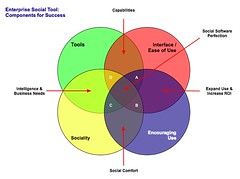
Enterprise 2.0 is more than just tools (see my Enterprise Social Tools: Components for Success for better understanding) as it also includes interface/interaction design for ease of use, sociality, and encouragement of use. The two biggest factors that are needed inside an organization that can receive less attention on the web are the sociality and encouragement of use.

Understanding sociality is incredibly important inside an organization as people are used to working in groups (often vertical in their hierarchy) that have been dictated to them for use. When the walls are broken down and people are self-finding others with similar interests and working horizontally and diagonally connecting and sharing with others and consuming the collective flows of information their comfortable walls of understanding are gone. A presentation in Copenhagen at Reboot on Freely Seeping Through the Walls of the Garden focussed just on this issue. This fear inside the enterprise is real. Much of the fear is driven by lacking conceptual models and understanding the value they will derive from using the tools and services. People need to know who the other people are that they are sharing with and what their motivations are (to some degree) before they have comfort in sharing themselves.

Encouraging use is also central to increased adoption inside organizations. Many organizations initial believe that Web 2.0 tools will take off and have great adoption inside an organization. But, this is not a "build it and they will come" scenario, even for the younger workers who are believed to love these tools and services and will not stay in a company that does not have them. The reality is the tools need selling their use, value derived from them, the conceptual models around what they do, and easing fears. Adoption rates grow far beyond the teen percentages in organizations that take time guiding people about the use of the tools and services. Those organizations that take the opportunity to continually sell the value and use for these tools they have in place get much higher adoption and continued engagement with the tools than those who do nothing and see what happens.

Gaps in Enterprise Tools

The last related statement was around the gaps in current and traditional enterprise tools. At the fantastic Jive Enterprise UI Summit in Aspen a few weeks ago there was a lot of discussion about enterprise tools, their UI, and ease of use for employees by the incredible collection of people at the event. One of the things that was shown was a killer path of use through a wide encompassing enterprise toolset that was well designed and presented by SAP's Dan Rosenberg who has done an incredible job of putting user experience and thinking through the needed workflows and uses of enterprise tools at the forefront of enterprise software planning. Given the excellent design and incredible amount of user experience thought that went into the tools behind the SAP toolset in the scenario (one of the best I have seen - functioning or blue sky demoed) there are still gaps. Part of this is identifying of gaps comes from traditional business thinking around formal processes and the tools ensure process adherence. But, the reality is the tools are quite often inflexible (I am not talking about SAP tools, but traditional enterprise tools in general), the cost of time and effort is beyond the gain for individuals to document and annotate all decisions and steps along the way. The hurdles to capture information and share it are often too large for capturing one to 10 quick sentences of information that can be retained for one's own benefit or shared with other where it is relevant.

There is another gap in business around the collective intelligence that is needed, which can lead to collaboration. Most businesses and their tools focus on collaboration and set groups, but at the same time wonder why they do not know what their company knows and knowledge is not all being captured. First there is a difference between collective and collaborative activities and the tools and design around and for those different activities is more than a nuance of semantics it is a huge barrier to capturing, sharing, and learning from information that leads to knowledge if it is not understood well. Enterprise has gone through its phases of knowledge management tools, from forms for capturing information, forums for sharing, and up to enterprise content management systems (ECM) that encompass document management, content management, knowledge management, and information harvesting. But, the gaps still exist.

These existing gaps are around conversations not being captured (the walls of the halls have no memory (well today they do not)) and increasingly the ubiquitous communication channel in organizations, e-mail, is being worked around. Quick decisions are not being documented as it is not enough for a document or worth completing a form. As the iterative processes of development, design, and solution engineering are happening at quicker and smaller increments the intelligence behind the decisions is not being captured or shared. This is largely because of the tools.

As has always been the case large enterprise systems are worked around through the use of smaller and more nimble solutions that augment the existing tools. Even in Dan's incredible demo I saw gaps for these tools. The quick tools that can fill these gaps are blogs, wikis, social bookmarking, tagging, Twitter type sharing, Veodia type video sharing, instant messaging, etc. There are many avenues to quickly capture information and understanding and share it. These tools get out of the way and allow what is in someone's head to get digitized and later structured by the individual themselves or other people whom have had the information shared with them in a community space. This turns into flows through streams that can be put into many contexts and needs as well as reused as needed.

Another point Dan stated at the Enterprise UI Summit that is dead on, is organizations are moving out of the vertical structures and moving to the horizontal. This is having a profound effect on the next generation of business tools and processes. This is also an area for Enterprise 2.0 tools as they easily open up the horizontal and diagonal prospects and tie into it the capability for easily understanding who these newly found people are in an organization through looking at their profiles, which eases their fears around sharing and unfamiliar environments as well as their related tasks.

[Comments are open and moderated at Tale of Two Tunnels: Web 2.0 and Enterprise 2.0 :: Personal InfoCloud]


11 June 2008

"Building the social web" Full-day Workshop in Copenhagen on June 30th

Through the wonderful cosponsoring of FatDUX I am going to be putting on a full-day workshop Building the Social Web on June 30th in Copenhagen, Denmark (the event is actually in Osterbro). This is the Monday following Reboot, where I will be presenting.

I am excited about the workshop as it will be including much of my work from the past nine months on setting social foundations for successful services, both on the web and inside organizations on the intranet. The workshop will help those who are considering, planning, or already working on social sites to improve the success of the services by providing frameworks that help evaluating and guiding the social interactions on the services.

Space is limited for this workshop to 15 seats and after its announcement yesterday there are only 10 seats left as of this moment.


7 May 2008

Enterprise Social Tools: Components for Success

One of the things I continually run across talking with organizations deploying social tools inside their organization is the difficultly getting all the components to mesh. Nearly everybody is having or had a tough time with getting employees and partners to engage with the services, but everybody is finding out it is much more than just the tools that are needed to consider. The tools provide the foundation, but once service types and features are sorted out, it get much tougher. I get frustrated (as do many organizations whom I talk with lately) that social tools and services that make up enterprise 2.0, or whatever people want to call it, are far from the end of the need for getting it right. There is great value in these tools and the cost of the tools is much less than previous generations of enterprise (large organization) offerings.

Social tools require much more than just the tools for their implementation to be successful. Tool selection is tough as no tool is doing everything well and they all are focussing on niche areas. But, as difficult as the tool selection can be, there are three more elements that make up what the a successful deployment of the tools and can be considered part of the tools.

Four Rings of Enterprise Social Tools

Enterprise Social Tool: Components for Success The four elements really have to work together to make for a successful services that people will use and continue to use over time. Yes, I am using a venn diagram for the four rings as it helps point out the overlaps and gaps where the implementations can fall short. The overlaps in the diagram is where the interesting things are happening. A year ago I was running into organizations with self proclaimed success with deployments of social tools (blogs, wikis, social bookmarking, forums, etc.), but as the desire for more than a simple set of blogs (or whichever tool or set of tools was selected) in-house there is a desire for greater use beyond some internal early adopters. This requires paying close attention to the four rings.

Tools

The first ring is rather obvious, it is the tools. The tools come down to functionality and features that are offered, how they are run (OS, rack mount, other software needed, skills needed to keep them running, etc.), how the tools are integrated into the organization (authentication, back-up, etc.), external data services, and the rest of the the usual IT department checklist. The tools get a lot of attention from many analysts and tech evangelists. There is an incredible amount of attention on widgets, feeds, APIs, and elements for user generated contribution. But, the tools do not get you all of the way to a successful implementation. The tools are not a mix and match proposition.

Interface & Ease of Use

One thing that the social software tools from the consumer web have brought is ease of use and simple to understand interfaces. The tools basically get out of the way and bring in more advanced features and functionality as needed. The interface also needs to conform to expectations and understandings inside an organization to handle the flow of interaction. What works for one organization may be difficult for another organization, largely due to the tools and training, and exposure to services outside their organization. Many traditional enterprise tools have been trying to improve the usability and ease of use for their tools over the last 4 to 5 years or so, but those efforts still require massive training and large binders that walk people through the tools. If the people using the tools (not administering the tools need massive amounts of training or large binders for social software the wrong tool has been purchased).

Sociality

Sociality is the area where people manage their sharing of information and their connections to others. Many people make the assumption that social tools focus on everything being shared with everybody, but that is not the reality in organizations. Most organizations have tight boundaries on who can share what with whom, but most of those boundaries get in the way. One of the things I do to help organizations is help them realize what really needs to be private and not shared is often much less than what they regulate. Most people are not really comfortable sharing information with people they do not know, so having comfortable spaces for people to share things is important, but these spaces need to have permeable walls that encourage sharing and opening up when people are sure they are correct with their findings.

Sociality also includes the selective groups people belong to in organizations for project work, research, support, etc. that are normal inside organizations to optimize efficiency. But, where things get really difficult is when groups are working on similar tasks that will benefit from horizontal connections and sharing of information. This horizontal sharing (as well as diagonal sharing) is where the real power of social tools come into play as the vertical channels of traditional organization structures largely serve to make organizations inefficient and lacking intelligence. The real challenge for the tools is the capability to surface the information of relevance from selective groups to other selective groups (or share information more easily out) along the way. Most tools are not to this point yet, largely because customers have not been asking for this (it is a need that comes from use over time) and it can be a difficult problem to solve.

One prime ingredient for social tool use by people is providing a focus on the people using the tools and their needs for managing the information they share and the information from others that flow through the tool. Far too often the tools focus on the value the user generated content has on the system and information, which lacks the focus of why people use the tools over time. People use tools that provide value to them. The personal sociality elements of whom are they following and sharing things with, managing all contributions and activities they personally made in a tool, ease of tracking information they have interest in, and making modifications are all valuable elements for the tools to incorporate. The social tools are not in place just to serve the organization, they must also serve the people using the tools if adoption and long term use important.

Encouraging Use

Encouraging use and engagement with the tools is an area that all organizations find they have a need for at some point and time. Use of these tools and engagement by people in an organization often does not happen easily. Why? Normally, most of the people in the organization do not have a conceptual framework for what the tools do and the value the individuals will derive. The value they people using the tools will derive needs to be brought to the forefront. People also usually need to have it explained that the tools are as simple as they seem. People also need to be reassured that their voice matters and they are encouraged to share what they know (problems, solutions, and observations).

While the egregious actions that happen out on the open web are very rare inside an organization (transparency of who a person is keeps this from happening) there is a need for a community manager and social tool leader. This role highlights how the tools can be used. They are there to help people find value in the tools and provide comfort around understanding how the information is used and how sharing with others is beneficial. Encouraging use takes understanding the tools, interface, sociality, and the organization with its traditions and ways of working.

The Overlaps

The overlaps in the graphic are where things really start to surface with the value and the need for a holistic view. Where two rings over lap the value is easy to see, but where three rings overlap the missing element or element that is deficient is easier to understand its value.

Tools and Interface

Traditional enterprise offerings have focussed on the tools and interface through usability and personalization. But the tools have always been cumbersome and the interfaces are not easy to use. The combination of the tools and interface are the core capabilities that traditionally get considered. The interface is often quite flexible for modification to meet an organizations needs and desires, but the capabilities for the interface need to be there to be flexible. The interface design and interaction needs people who have depth in understanding the broad social and information needs the new tools require, which is going to be different than the consumer web offerings (many of them are not well thought through and do not warrant copying).

Tools and Sociality

Intelligence and business needs are what surface out of the tools capabilities and sociality. Having proper sociality that provides personal tools for managing information flows and sharing with groups as well as everybody as it makes sense to an individual is important. Opening up the sharing as early as possible will help an organization get smarter about itself and within itself. Sociality also include personal use and information management, which far few tools consider. This overlap of tools and sociality is where many tools are needing improvement today.

Interface and Encouraging Use

Good interfaces with easy interaction and general ease of use as well as support for encouraging use are where expanding use of the tools takes place, which in turn improves the return on investment. The ease of use and simple interfaces on combined with guidance that provides conceptual understanding of what these tools do as well as providing understanding that eases fears around using the tools (often people are fearful that what they share will be used against them or their job will go away because they shared what they know, rather than they become more valuable to an organization by sharing as they exhibit expertise). Many people are also unsure of tools that are not overly cumbersome and that get out of the way of putting information in to the tools. This needs explanation and encouragement, which is different than in-depth training sessions.

Sociality and Encouraging Use

The real advantages of social tools come from the combination of getting sociality and encouraging use correct. The sociality component provides the means to interact (or not) as needed. This is provided by the capabilities of the product or products used. This coupled with a person or persons encouraging use that show the value, take away the fears, and provide a common framework for people to think about and use the tools is where social comfort is created. From social comfort people come to rely on the tools and services more as a means to share, connect, and engage with the organization as a whole. The richness of the tools is enabled when these two elements are done well.

The Missing Piece in Overlaps

This section focusses on the graphic and the three-way overlaps (listed by letter: A; B; C; and D). The element missing in the overlap or where that element is deficient is the focus.

Overlap A

This overlap has sociality missing. When the tool, interface, and engagement are solid, but sociality is not done well for an organization there may be strong initial use, but use will often stagnate. This happens because the sharing is not done in a manner that provides comfort or the services are missing a personal management space to hold on to a person's own actions. Tracking one's own actions and the relevant activities of others around the personal actions is essential to engaging socially with the tools, people, and organization. Providing comfortable spaces to work with others is essential. One element of comfort is built from know who the others are whom people are working with, see Elements of Social Software and Selective Sociality and Social Villages (particularly the build order of social software elements) to understand the importance.

Overlap B

This overlap has tools missing, but has sociality, interface, and encouraging use done well. The tools can be deficient as they may not provide needed functionality, features, or may not scale as needed. Often organizations can grow out of a tool as their needs expand or change as people use the tools need more functionality. I have talked with a few organizations that have used tools that provide simple functionality as blogs, wikis, or social bookmarking tools find that as the use of the tools grows the tools do not keep up with the needs. At times the tools have to be heavily modified to provide functionality or additional elements are needed from a different type of tool.

Overlap C

Interface and ease of use is missing, while sociality, tool, and encouraging use are covered well. This is an area where traditional enterprise tools have problems or tools that are built internally often stumble. This scenario often leads to a lot more training or encouraging use. Another downfall is enterprise tools are focussed on having their tools look and interact like consumer social web tools, which often are lacking in solid interaction design and user testing. The use of social tools in-house will often not have broad use of these consumer services so the normal conventions are not understood or are not comfortable. Often the interfaces inside organizations will need to be tested and there many need to be more than one interface and feature set provided for depth of use and match to use perceptions.

Also, what works for one organization, subset of an organization, or reviewer/analyst will not work for others. The understanding of an organization along with user testing and evaluation with a cross section of real people will provide the best understanding of compatibility with interface. Interfaces can also take time to take hold and makes sense. Interfaces that focus on ease of use with more advanced capabilities with in reach, as well as being easily modified for look and interactions that are familiar to an organization can help resolve this.

Overlap D

Encouraging use and providing people to help ease people's engagement is missing in many organizations. This is a task that is often overlooked. The tools, interface, and proper sociality can all be in place, but not having people to help provide a framework to show the value people get from using the tools, easing concerns, giving examples of uses for different roles and needs, and continually showing people success others in an organization have with the social tool offerings is where many organization find they get stuck. The early adopters in an organization may use the tools as will those with some familiarity with the consumer web social services, but that is often a small percentage of an organization.

Summary

All of this is still emergent and early, but these trends and highlights are things I am finding common. The two areas that are toughest to get things right are sociality and encouraging use. Sociality is largely dependent on the tools, finding the limitations in the tools takes a fair amount of testing often to find limitations. Encouraging use is more difficult at the moment as there are relatively few people who understand the tools and the context that organizations bring to the tools, which is quite different from the context of the consumer social web tools. I personally only know of a handful or so of people who really grasp this well enough to be hired. Knowing the "it depends moments" is essential and knowing that use is granular as are the needs of the people in the organization. Often there are more than 10 different use personas if not more that are needed for evaluating tools, interface, sociality, and encouraging use (in some organizations it can be over 20). The tools can be simple, but getting this mix right is not simple, yet.

[Comments are open and moderated at Enterprise Social Tools: Components for Success :: Personal InfoCloud


16 April 2008

Explaining the Granular Social Network

This post on Granular Social Networks has been years in the making and is a follow-up to one I previously made in January 2005 on Granular Social Networks as a concept I had been presenting and talking about for quite some time at that point. In the past few years it has floated in and out of my presentations, but is quite often mentioned when the problems of much of the current social networking ideology comes up. Most of the social networking tools and services assume we are broadline friends with people we connect to, even when we are just "contacts" or other less than "friend" labels. The interest we have in others (and others in us) is rarely 100 percent and even rarer is that this 100 percent interest and appreciation is equal in both directions (I have yet to run across this in any pairing of people, but I am open to the option that it exists somewhere).

Social Tools Need to Embrace Granularity

What we have is partial likes in others and their interests and offerings. Our social tools have yet to grasp this and the few that do have only taken small steps to get there (I am rather impressed with Jaiku and their granular listening capability for their feed aggregation, which should be the starting point for all feed aggregators). Part of grasping the problem is a lack of quickly understanding the complexity, which leads to deconstructing and getting to two variables: 1) people (their identities online and their personas on various services) and 2) interests. These two elements and their combinations can (hopefully) be seen in the quick annotated video of one of my slides I have been using in presentations and workshops lately.

Showing Granular Social Network


Granular Social Network from Thomas Vander Wal on Vimeo.

The Granular Social Network begins with one person, lets take the self, and the various interest we have. In the example I am using just five elements of interest (work, music, movies, food, and biking). These are interest we have and share information about that we create or find. This sharing may be on one service or across many services and digital environments. The interests are taken as a whole as they make up our interests (most of us have more interests than five and we have various degrees of interest, but I am leaving that out for the sake of simplicity).

Connections with Others

Our digital social lives contain our interests, but as it is social it contains other people who are our contacts (friends is presumptive and gets in the way of understanding). These contacts have and share some interests in common with us. But, rarely do the share all of the same interest, let alone share the same perspective on these interests.

Mapping Interests with Contacts

But, we see when we map the interests across just six contacts that this lack of fully compatible interests makes things a wee bit more complicated than just a simple broadline friend. Even Facebook and their touted social graph does not come close to grasping this granularity as it is still a clumsy tool for sharing, finding, claiming, and capturing this granularity. If we think about trying a new service that we enjoy around music we can not easily group and capture then try to identify the people we are connected to on that new service from a service like Facebook, but using another service focussed on that interest area it could be a little easier.

When we start mapping our own interest back to the interest that other have quickly see that it is even more complicated. We may not have the same reciprocal interest in the same thing or same perception or context as the people we connect to. I illustrate with the first contact in yellow that we have interest in what they share about work or their interest in work, even though they are not stating or sharing that information publicly or even in selective social means. We may e-mail, chat in IM or talk face to face about work and would like to work with them in some manner. We want to follow what they share and share with them in a closer manner and that is what this visual relationship intends to mean. As we move across the connections we see that the reciprocal relationships are not always consistent. We do not always want to listen to all those who are sharing things, with use or the social collective in a service or even across services.

Focus On One Interest

Taking the complexity and noise out of the visualization the focus is placed on just music. We can easily see that there are four of our six contacts that have interest in music and are sharing their interest out. But, for various reasons we only have interests in what two of the four contacts share out. This relationship is not capturing what interest our contacts have in what we are sharing, it only captures what they share out.

Moving Social Connections Forward

Grasping this as a relatively simple representation of Granular Social Networks allows for us to begin to think about the social tools we are building. They need to start accounting for our granular interests. The Facebook groups as well as listserves and other group lists need to grasp the nature of individuals interests and provide the means to explicitly or implicitly start to understand and use these as filter options over time. When we are discussing portable social networks this understanding has be understood and the move toward embracing this understanding taken forward and enabled in the tools we build. The portable social network as well as social graph begin to have a really good value when the who is tied with what and why of interest. We are not there yet and I have rarely seen or heard these elements mentioned in the discussions.

One area of social tools where I see this value beginning to surface in through tagging for individuals to start to state (personally I see this as a private or closed declaration that only the person tagging see with the option of sharing with the person being tagged, or at least have this capability) the reasons for interest. But, when I look at tools like Last.fm I am not seeing this really taking off and I hear people talking about not fully understanding tagging as as it sometimes narrows the interest too narrowly. It is all an area for exploration and growth in understanding, but digital social tools, for them to have more value for following and filtering the flows in more manageable ways need to more in grasping this more granular understanding of social interaction between people in a digital space.


Social Tools for Mergers and Acquisitions

The announcement yesterday of Delta and Northwest airlines merging triggered a couple thoughts. One of the thoughts was sadness as I love the unusually wonderful customer service I get with Northwest, and loathe the now expected poor and often nasty treatment by Delta staff. Northwest does not have all the perks of in seat entertainment, but I will go with great customer service and bags that once in nearly 50 flights did not arrive with me.

But, there is a second thing. It is something that all mergers and large organization changes trigger...

Social Tools Are Great Aids for Change

Stewart Mader brought this to mind again in his post Onboarding: getting your new employees cleared for takeoff, which focusses on using wikis (he works for Atlassian and has been a strong proponent of wikis for years and has a great book on Wiki Patterns) as a means to share and update the information that is needed for transitions and the joining of two organizations.

I really like his write-up and have been pushing the social tools approach for a few years. The wiki is one means of gathering and sharing information. It is a good match with social bookmarking, which allows organizations that are coming together have their people find and tag things in their own context and perspective. This provides finding common objects that exist, but also sharing and learning what things are called from the different perspectives.

Communication Build Common Ground

Communication is a key cornerstone to any organization working with, merging with, or becoming a part of another. Communication needs common ground and social bookmarking that allows for all context and perspectives to be captured is essential to making this a success.

This is something I have presented on and provided advice in the past and really think and have seen that social tools are essentials in these times of transition. It is really rewarding when I see this working as I have been through organization mergers, going public, and major transitions in the days before these tools existed. I can not imaging thinking of transitioning with out these tools and service today. I have talked to many organizations after the fact that wished they had social bookmarking, blogs, and wikis to find and annotate items, provide the means to get messages out efficiently (e-mail is becoming a poor means of sharing valuable information), and working toward common understanding.

One large pain point in mergers and other transitions is the cultural change that brings new terms, new processes, new workflow, and disruption to patterns of understanding that became natural to the people in the organization. The ability to map what something was called and the way it was done to what it is now called and the new processes and flows is essential to success. This is exactly what the social tools provide. Social bookmarking is great for capturing terms, context, and perspectives and providing the ability to refind these new items using prior understanding with low cognitive costs. Blogs help communicate people's understanding as they are going through the process as well as explain the way forward. Wikis help map these individual elements that have been collectively provided and pull them together in one central understanding (while still pointing out to the various individual contributions to hold on to that context) in a collaborative (working together with one common goal) environment.

Increasing Speed and Lowering Cost of Transition

Another attribute of the social tools is the speed and cost at which the information is shared, identified, and aggregated. In the past the large consulting firms and the slow and expensive models for working were have been the common way forward for these times of change. Seeing social tools along with a few smart and nimble experts on solid deployments and social engagement will see similar results in days and a handful of weeks compared to many weeks and months of expensive change management plodding. The key is the people in the organizations know their concerns and needs, while providing them the tools to map their understanding and finding information and objects empowers the individuals while giving them knowledge and the means to share with others. This also helps the individuals grasp that are essential to the success and speed to the change. Most people resent being pushed and prodded into change and new environments, giving them the tools to understand and guide their own change management is incredibly helpful. This decreases the time for transition (for processes and emotionally) while also keeping the costs lower.

[Comments are open and moderated as always in the post at: Social Tools to Efficiently Build Common Ground :: Personal InfoCloud]


10 April 2008

Denning and Yaholkovsky on Real Collaboration

The latest edition of the Communications of the ACM (Volume 51, Issue 4 - April 2008) includes an article on Getting to "we", which starts off by pointing out the misuse and mis-understanding of the term collaboration as well as the over use of the practice of collaboration when it is not proper for the need. The authors Peter Denning and Peter Yaholkovsky break down the tools needed for various knowledge needs into four categories: 1) Information sharing; 2) Coordination; 3) Cooperation; and Collaboration. The authors define collaboration as:

Collaboration generally means working together synergistically. If your work requires support and agreement of others before you can take action, you are collaborating.

The article continues on to point out that collaboration is often not the first choice of tools we should reach for, as gathering information, understanding, and working through options is really needed in order to get to the stages of agreement. Their article digs deeply into the resolving "messy problems" through proper collaboration methods. To note, the wiki - the usual darling of collaboration - is included in their "cooperation" examples and not Collaboration. Most of the tools many businesses consider in collaboration tools are in the lowest level, which is "information sharing". But, workflow managment falls into the coordination bucket.

This is one of the better breakdowns of tool sets I have seen. The groupings make a lot of sense and their framing of collaboration to take care of the messiest problems is rather good, but most of the tools and services that are considered to be collaborations tools do not even come close to that description or to the capabilities required.

[Comments are open at Denning and Yaholkovsky on Real Collaboration :: Personal InfoCloud]


30 March 2008

Understanding Collective and Collaborative

I have finally blogged about the different between the two terms of collaborative and collective, which has been something bugging me for some time. Comments there are open, but are moderated (as they always have been). Those who have been to any of my workshops in the past year or so will see familiar information. Hopefully, the post will help those discussing and crafting social tools for the general web (or mobile) or large organizations will read and work to grasp the difference. I have had plenty of academics, researchers, and service developers push me to make this public for far too long so to start getting the misunderstanding around the two terms corrected.


22 February 2008

Remote Presentation and Perception Matrix for Social Tools

This post is also found at: Remote Presentation and Perceptions Matrix for Social Tools :: Personal InfoCloud with moderated comments turned on.]

Today I did something I had never done before (actually a few things) I sat in my office in my home and gave a live web video presentation to a conference elsewhere on the globe. I presented my nearly all new presentation, Keeping Up With Social Tagging to the Expert Workshop in: Social Tagging and Knowledge Organization - Perspectives and Potential that was put on by the Knowledge Media Research Center in Tübingen, Germany.

Remote Presentation Feelings

While the remote video presentation is normal for many people inside their large organizations and I have presented at meetings and conferences where my presentation was provided to other location on live video feed (my recent Ann Arbor trip to present at STIET was HD broadcast to Wayne State in Detroit), this home office to conference presentation was new to me. The presentation and video link used Adobe Connect, which allowed me to see whom I was talking to, manage my slides, text chat, and see myself. This worked quite well, much better than I expected. I did have my full slide presentation in lightroom view set up in Keynote on my external monitor on the side and used Awaken on the side monitor as well to help with timing.

The ability to get feedback and watch the attendees body language and non-verbal responses was insanely helpful. I have given webinars and done phone presentations where I had not visual cues to the audience responses, which I find to be a horrible way to present (I often will expand on subjects or shorten explanations based on non-verbal feedback from the audience). Adobe Connect allowed this non-verbal feedback to be streamed back to me, which completely allows me to adjust the presentation as I normally do.

One thing that was a wee bit difficult was having to change focus (I suppose that comes with use and experience), but I would watch audience feedback while presenting, peek to the side to see where I was with time and slides (to work in the transitions), but would then try to look at the camera to "connect". Watching myself on the video feedback the moments I would try to connect through the camera I would open my eyes wide as if trying to see through my iSight and boy does that come across looking strange on a close range camera. I also (unknown to myself until recently watching a video of another presentation I had done) use a similar facial expression to add emphasis, I am realizing with a camera as close as it is for web presentation also really looks odd. I am sort of used to listening to myself (normally to write out new analogies I use or responses to questions), but watching myself in playback from that close of a range is really uncomfortable.

One thing I really missed in doing this web video presentation was extended interaction with the attendees. I rather enjoy conferences, particularly ones with this focussed a gathering as it makes for great socializing with people passionate about the same subjects I am passionate about. I like comparing note, perceptions, and widely differing views. It helps me grow my knowledge and understandings as well as helps change my perceptions. Live face-to-face conversation and sharing of interests is an incredibly value part of learning, experiencing, and shaping views and it is something I greatly enjoy attending conferences in person. I am not a fan of arriving at a conference just prior to a presentation, giving the presentation, and then leaving. The personal social interaction is valuable. The video presentation does not provide that and I really missed it, particularly with the people who are so closely tied to my deep interest areas as this workshop was focused.

New Content in Presentation

This presentation included a lot of new content, ideas, and concepts that I have not really presented or written about in as open of a forum. I have received really strong positive feedback from the Faces of Perception, Depth of Perception, and Perception Matrix when I have talked about it with people and companies. I have included this content in the book on social bookmarking and folksonomy I am writing for O&Reilly and pieces have been in public and private workshops I have given, but it was long past time to let the ideas out into the open.

The components of perception came about through reading formal analysis and research from others as well as not having a good models myself to lean on to explain a lot of what I find from social computing service providers (web tools in the Web 2.0 genre as well as inside the firewall Enterprise 2.0 tools) as tool makers or service owners. The understandings that are brought to the table on a lot of research and analysis is far too thin and far too often badly confuses the roles and faces of the tool that are being reviewed or analyzed. In my working with tool makers and organizations implementing social tools the analysis and research is less than helpful and often makes building products that meet the user needs and desires really difficult. I am not saying that this conceptual model fixes it, but from those who have considered what it shows almost all have had realizations they have had a less than perfect grasp and have lacked the granularity they have needed to build, analyze, or research these social tools.

I am hoping to write these perspectives up in more depth at some point in the not too distant future, but the video and slides start getting the ideas out there. As I have been walking people through how to use the tools I have been realizing the content needed to best us the model and matrix may take more than a day of a workshop of even a few days to get the most complete value from it. These tools have helped me drastically increase my value in consulting and training in the very short time I have used them. Some are finding that their copying of features and functionality in other social services has not helped them really understand what is best for their user needs and are less than optimal for the type of service they are offering or believe they are offering.


8 February 2008

Getting More Value In Enterprise with Social Bookmarking

The last few weeks I have been running across a few companies postponing or canceling their social computing or Enterprise 2.0 efforts. The reasons vary from the usual budget shifts and staff changes (prior projects were not delivered on time), and leadership roles need filling. But two firms had new concerns of layoffs or budget cuts.

To both firms I pointed out now was the exact time they really needed to focus on some Enterprise 2.0 efforts, particularly social bookmarking as well as wikis and blogs. These solutions help gather information, find value across the organization, capture knowledge, build cohesiveness for members of the organization in time where there there is uncertainty. One of the biggest reasons that these tools make sense is their cost to deploy and receive solid value. As Josh Bernoff  (and others in from Forrester) points out in the Strategies For Interactive Marketing In A Recession free report from Forrester, the cost to deploy is in the $50,000 to $300,000 range (usually more expensive for large and more complex deployments).

Social Bookmarking has Great Value in the Enterprise

Every organization needs to know itself better then they currently do. The employees and members of the organization are all trying to do their job better and smarter. The need to connect people inside an organization with others with similar interest, contexts, and perceptions is really needed. I am a huge fan of social bookmarking tools to help along these lines as it helps people hold on to information they have need, want, or have interest in (particularly with future uses) and put things in their own context and perception. Once people understand the value they derive from using the tools to hold on to information out of their vast flow and streams of information and data that run before them each day they quickly "get it". As people also share these bookmarks in the organization with their tags and annotations, they also realize quickly they are becoming a valuable conduit to helping others find information and they grasp the value they will derive from being a resource that adds value in the organization. Other people derive value from information in the organization and outside it being augmented with individual perspectives and context. When this is pair with search, as Connectbeam does with their social search that pairs with existing FAST, Google Search Appliance, and others in-house search engines, the value the whole organization receives is far beyond the cost and minimal effort people are putting into the tools to get smarter, by more easily holding on and sharing what they know.

Nearly every attendee to the workshops I have put on around this subject quickly realizes they undervalued the impact and capability of social bookmarking (as well as other social computing tools) in the enterprise. The also provides a strong foundation for better understanding social computing to increase the derived value for all parties (individuals, collective users, collaborative users, and the organization).

Is is time for your enterprise to get smarter and provide more value inside and out?

[This is also blogged at Getting More Value In Enterprise with Social Bookmarking :: Personal InfoCloud with moderated comments turned on.]


10 January 2008

Posting Elements of the Social Software Stack

I have been working for quite on finding a good way to explain the elements in the social software stack (or most of the important ones). I have blogged the result of the work as The Elements in the Social Software Stack (comments are open there).

In my public and in-house workshops I have worked through various graphics from others and my own to work as a foundation for talking to and through the subject. In November I finally sat down (in a hallway open space) the day before my workshop at the IA Konferenz in Stuttgart, Germany. It had all the elements that are part of a solid foundation, in progressive order:

  1. Identity
  2. Object (social object)
  3. Presence
  4. Actions
  5. Sharing
  6. Reputation
  7. Relationships
  8. Conversation
  9. Groups
  10. Collaboration

This and one other post that is in the works are becoming the corner stones for my work helping start-ups and enterprise work through social software (social computing) to properly solve their problems and address the issues at hand. It has also been the foundation for rethinking (mostly more clearly thinking about) social bookmarking and folksonomy. I am rewriting the work I have done toward the book based on these two pieces as it is making the communication of concepts clearer.

Who Does This Help?

People looking at the social software services should have a solid idea of the central elements, identity and the social object. After that it is a building process to account for the other elements leading up to the services full offerings. Social bookmarking (folksonomy related services) should get up to or include conversation. Tools like Ma.gnolia go up to groups for their social bookmarking service and they cover the elements leading up to that end point.

There is more that can be fleshed out in this, but it is a foundation and a starting point. The next piece will build on this posting and should be a good foundation for understanding.

Still here? Go read The Elements in the Social Software Stack :: Personal InfoCloud and offer constructive feedback. Thank you.


3 November 2007

Can Facebook Change Its DNA

I wrote and posted Can Facebook Change Its DNA as a follow-up to for Business or LinkedIn Gets More Valuable regarding the changes needed in Facebook if it wants to be valuable (or have optimal value) for the business world.


20 August 2007

Why Ma.gnolia is One of My Favorite Social Bookmarking Tools

After starting the Portable Social Network Group in Ma.gnolia yesterday I received a few e-mails and IMs regarding my choice. Most of the questions were why not just use tags and del.icio.us. After I posted my Ma.Del Tagging Bookmarklet post I have had a lot of questions about Ma.gnolia and my preference as well as people thought I was not a fan of it. I have been thinking I would blog about my usage, but given my work advising on social bookmarking and social web, I shy away talking about what I use as what I like is likely not what is going to be a good fit for others. But, my work is one of the reasons I want to talk about what I like using as nearly every customer of mine and many presentation attendees look at del.icio.us first (it kicked the door wide open with a tool that was light years ahead of all others), but it is not for everybody and there are many other options. Much of my work is with enterprise and organizations of various size, which del.icio.us is not right for them for privacy reasons. I still add to del.icio.us along with my favorite as there are many people that have subscribed to the at feed as they derive value from that subscription so I take the extra step to keep that feed as current.

Ma.gnolia Offers Great Features for Sociality

I have two favorite tools for my own personal social bookmarking reasons Ma.gnolia and Clipmarks (I don't think I have anything publicly shared in Clipmarks). First the later, I use Clipmarks primarily when I only want to bookmark a sub-page element out on the web, which are paragraphs, sentences, quotes, images, etc.

I moved to try Ma.gnolia again last Fall when something changed in del.icio.us search and the results were not returning things that were in del.icio.us. My trying Ma.gnolia, by importing all of my 2200 plus bookmarks not only allowed me to search and find things I wanted, but I quickly became a fan of their many social features. In the past year or less they have become more social in insanely helpful and kind ways. Not only does Ma.gnolia have groups that you can share bookmarks with but there is the ability to have discussions around the subject in those groups. Sharing with a group is insanely easy. Groups can be private if the manager wishes, which makes it a good test ground for businesses or other organizations to test the social bookmarking waters. I was not a huge fan of rating bookmarks as if I bookmarked something I am wanting to refind it, but in a more social context is has value for others to see the strength of my interest (normall 3 to 5 stars). One of my favorite social features is giving "thanks", which is not a trigger for social gaming like Digg, but is an interpersonal expression of appreciation that really makes Ma.gnolia a friendly and positive social environment.

Started with Beauty, but Now with Ease

Ma.gnolia started as a beautiful del.icio.us (it was not the first) and the beauty got in the way of usability for many. But, Ma.gnolia has kept the beautiful strains and added simple ease of use in a very Apple delightful moments sort of way. The thanks are a nice treat, but the latest interactions that provide non-disruptive ease of use to accomplish a task, without completely taking you away from your previous flow (freaking brilliant in my viewpoint - anything that preserves flow to accomplish a short task is a great step). Another killer feature is Ma.gnolia Roots, which is a bookmarklet that when clicked hovers a semi-transparent layer over the webpage to show information from Ma.gnolia about that page (who has linked to it, tags, annotations, etc.) and makes it really easy to bookmark that page from that screen. The API (including a replica of the del.icio.us API that nearly all services use as the standard), add-ons, Creative Commons license for your bookmarks, many bookmarklet options, and feed options. But, there are also the little things that are not usually seen or noticed, such as great URLs that can be easily parsed, all pages are properly marked up semantically, and Microformats are broadly and properly used throughout the site (nearly at every pivot).

Intelligently Designed

For me Ma.gnolia is not only a great site to look at, a great social bookmarking site that is really social (as well as polite and respectful of my wishes), but a great example for semantic web mark-up (including microformats). There is so much attention to detail in the page markup that for those of us that care it is amazingly beautiful. The visual layer can be optimized for more white space and detail or for much easier scrolling. The interactions, ease of use, and delightful moments that assist you rather than taking you out of your flow (workflow, taskflow, etc.) and make you ask why all applications and social sites are not this wonderful.

Ma.gnolia is not perfect as it needs some tools to better manage and bulk edit your own bookmarks. It could use a sort on search items (as well as narrow by date range). Search could use some RedBull at times. It could improve with filtering by using co-occurance of tag terms as well as for disambiguation.

Overall for me personally, Ma.gnolia is a tool I absolutely love. It took the basic social bookmarking idea in del.icio.us and really made it social. It has added features and functionality that are very helpful and well executed. It is an utter pleasure to use. I can not only share things easily and get the wonderful effects of social interaction, but I can refind things in my now 2,500 plus bookmarks rather easily.


24 July 2007

Sharing and Following/Listening in the Social Web

You may be familiar with my granular social network post and the postings around the Personal InfoCloud posts that get to personal privacy and personal management of information we have seen, along with the Come to Me Web, but there is an element that is still missing and few social web sites actually grasp the concept. This concept is granular in the way that the granular social network is granular, which focusses on moving away from the concept of "broad line friends" that focus on our interest in everything people we "friend", which is not a close approximation of the non-digital world of friend that we are lucky to find friends who have 80 percent common interests. This bit that is missing focusses on the sharing and following (or listening) aspects of our digital relationships. Getting closer to this will help filter information we receive and share to ease the overflow of information and make the services far more valuable to the people using them.

Twitter Shows Understanding

Twitter in its latest modifications is beginning to show that it is grasping what we are doing online is not befriending people or claiming friend, but we are "following" people. This is a nice change, but it is only part of the equation that has a few more variables to it, which I have now been presenting for quite a few years (yes and am finally getting around to writing about). The other variables are the sharing and rough facets of type of information we share. When we start breaking this down we can start understanding the basic foundation for building a social web application that can begin to be functional for our spheres of sociality.

Spheres of Sociality

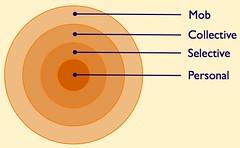
Spheres of Sociality The Spheres of Sociality are broken into four concentric rings:

  1. Personal
  2. Selective
  3. Collective
  4. Mob

There are echos of James Surowiecki's Wisdom of Crowds in the Spheres of Sociality as they break down as follows. The personal sphere is information that is just for one's self and it is not shared with others. The selective sphere, which there may be many a person shares with and listens to, are closed groups that people are comfortable sharing and participating with on common interests (family, small work projects, small group of friends or colleagues, etc.). The collective sphere is everybody using that social tool that are members of it, which has some common (precise or vague) understanding of what that service/site is about. The last sphere is the mob, which are those people outside the service and are not participants and who likely do not understand the workings or terminology of the service.

These sphere help us understand how people interact in real life as well as in these social environments. Many of the social web tools have elements of some of these or all of these spheres. Few social web tools provide the ability to have many selective spheres, but this is a need inside most enterprise and corporate sites as there are often small project teams working on things that may or may not come to fruition (this will be a future blog post). Many services allow for just sharing with those you grant to be your followers (like Twitter, Flickr, the old Yahoo! MyWeb 2.0, and Ma.gnolia private groups, etc.). This selective and segmented group of friends needs a little more examination and a little more understanding.

Granular Sharing and Following

Unequal AccessThe concepts that are needed to improve upon what has already been set in the Spheres of Sociality revolve around breaking down sharing and following (listening) into more discernible chunks that better reflect our interests. We need to do this because we do not always want to listen everything people we are willing to share with are surfacing. But, the converse is also true we may not want to share or need to share everything with people we want to follow (listen to).

In addition to each relationship needing to have sharing and listening properties, the broad brush painted by sharing and listening also needs to be broken down just a little (it could and should be quite granular should people want to reflect their real interests in their relationships) to some core facets. The core facets should have the ability to share and listen based on location, e.g. a person may only want to share or listen to people when they are in or near their location (keeping in mind people's location often changes, particularly for those that travel or move often). The location facet is likely the most requested tool particularly for those listening when people talk about Twitter and Facebook. Having some granular categories or tags to use as filters for sharing and listening makes sense as well. This can break down to simple elements like work, play, family, travel, etc. as broad categories it could help filter items from the sharing or listening streams and help bring to focus that which is of interest.

Breaking Down Listening and Sharing for Items

 YourselfOthers
ShareYesYes/No

Where this gets us it to an ability to quickly flag the importance of our interactions with others with whom we share information/objects. Some things we can set on an item level, like sharing or just for self, and if sharing with what parameters are we sharing things. We will set the default sharing with ourself on so we have access to everything we do. This follows the Spheres of Sociality with just personal use, sharing with selective groups (which ones), share with the collective group or service, and share outside the service. That starts setting privacy of information that starts accounting for personal and work information and who could see it. Various services have different levels of this, but it is a rare consumer services that has the selective service sorted out (Pownce comes close with the options for granularity, but Flickr has the ease of use and levels of access. For each item we share we should have the ability to control access to that item, to just self or out across the Spheres of Sociality to the mob, if we so wish. Now we can get beyond the item level to presetting people with normative rights.

Listening and Sharing at the Person Level

 Others
Settings
Listen/FollowYesNo
Granular
Listen/Follow
YesNo
Granular ShareYesNo
Geo Listen/FollowYesNo
Geo ShareYesNo

We can set people with properties that will help use with default Sphere of Sociality for sharing and listening. The two directions of communication really must be broken out as there are some people we do not mind them listening to the selective information sharing, but we may not have interest in listening to their normal flow of offerings (optimally we should be able to hear their responses when they are commenting on items we share). Conversely, there may be people we want to listen to and we do not want to share with, as we may not know them well enough to share or they may have broken our privacy considerations in the past, hence we do not trust them. For various reasons we need to be able to decide on a person level if we want to share and listen to that person.

Granular Listening and Sharing

Not, only do we have needs and desires for filtering what we share and listen to on the person level, but if we have a means to set some more granular levels of sharing, even at a high level (family, work, personal relation, acquaintance, etc.). If we can set some of these facets for sharing and have them tied to the Spheres we can easily control who and what we share and listen to. Flickr does this quite well with the simple family, friends, contacts, and all buckets, even if people do not use them precisely as such as family and friends are the two selective buckets they offer to work with (most people I know do not uses them precisely as such with those titles, but it provides a means of selective sharing and listening).

Geo Listening and Sharing

Lastly, it is often a request to filter listening and sharing by geography/location access. There are people who travel quite a bit and want to listen and share with people that are currently local or will be local to them in a short period, but their normal conversations are not fully relevant outside that location. Many people want the ability not to listen to a person unless they are local, but when a person who has some relationship becomes local the conversation may want to be shared and/or listened to. These settings can be dependent on the granular listening and sharing parameters, or may be different.

Getting There...

So, now that this is out there it is done? Hmmm, if it were only so easy. The first step is getting developers of social web and social software to begin understanding the social relationships that are less broad lines and more granular and directional. The next step is a social interaction that people need to understand or that the people building the interfaces need to understand, which is if and how to tell people the rights granted are not reciprocal (it is seems to be a common human trait to have angst over non-reciprocal social interactions, but it is the digital realm that makes it more apparent that the flesh world).


30 June 2007

A Love Ruined - Good Bye Palm

It used to be all love. It started in 1998 just after Christmas. It was a gift under the tree and it brought me wonderful joy. It was the Palm III by Palm. It allowed me to sync all of my address book info, my to do lists, and other "essentials" of a digital portable life. It was relatively easy to write applications for it and extend its usefulness. I learn the graffiti writing in three early mornings of waking-up on the West Coast on East Coast time.

That Palm lasted a few years and I then moved to the HandSpring Visor Deluxe, which had more internal memory, still based on the Palm operating system, and it had four times the memory. The device did most everything I needed. Just like my Palm III the HandSpring was reliable and always ready, it never failed me. I added a camera and some other tools for the plug-in slot and everything always worked.

Mobile Internet & Mobile E-mail

My big advancement was getting a Sidekick (Hiptop) that gave me web, chat, and e-mail all live and all in my pocket. I still kept the Visor as it still served a purpose (address book, notes, e-books). The Sidekick was not a great phone so I kept my Motorola 270C (a really great phone - did not much else). This was a stack of too many devices, particularly when an iPod came into my life.

Treo Moves In

Somewhere in the Spring of 2002 I got a Treo 600, which seemed like a great solution. I replaced my Sidekick, my Motorola, my Visor, and my watch (this was happenstance more than anything else). Things were good for the first 6 to 9 months, but the phone began to crash regularly after that. I had some hardware malfunctions and got a replacement. All was good again for 6 to 9 months then it started crashing when pulling e-mail and the phone rang. The hardware did not last that long on this either. By Fall (18 months after the first 600) the phone was in really poor state and I woke up one morning picked it up and it split (the day before traveling to the Bay Area). By this time the Treo 650 was out and I convinced my mobile provider to let me switch with out penalty. But the same story repeated at 6 to 9 months. After 10 months the keyboard stopped working and I got a replacement. I am 12 months into that replacement and life with this Treo is hell.

Treo Is Toiletware

The relationship with my Treo is so bad I constantly swear I am going to throw it in the toilet, but that would leave me with out a primary phone (I have an old Nokia I enjoy for international service and back-up but don't have many minutes with that carrier). The odd thing is I know quite a few people who used to work at Palm and none of them use a Palm device. All of them have had horrible problems with the Treo and it was their last device with a Palm operating system.

Palm seemed to have lost their love when they added the phone. The Treo is a really poor phone (horrible voice capability), but it also is short on memory and most useful applications were removed from the device as they needed more memory than was available or they crashed the device. Now my Treo is less useful than my Sidekick. It is a slow unreliable device. Palm went from being a company I utterly loved to one I hope dies a quick painful death. Everybody I know that has new devices say they are no better.

What is the Next Step

While I have interest in Blackberry devices, I like the open platform of Nokia and Nokia gets the phone part of the phone really well. The iPhone is interesting, but is missing the open platform, 3G, and proven platfor that Nokia has. I am still making up my mind, but I think the Nokia E61i is what I really want to replaced the horrible state the Treo has left me in.

I want a phone with decent camera, with e-mail, web, WiFi, touch keyboard, and ability to read e-books and docs easily. I want to be able to build and get solid applications that serve the purposes I need and do not crash the device.

Good bye Palm, I loved you deeply for a long time, but you betrayed me with your crap phones and lack of caring. It was not that I fell for another product, you did it to yourself.


This work is licensed under the Creative Commons Attribution-NonCommercial-ShareAlike License.