Off the Top: Social Software Entries

Showing posts: 121-135 of 137 total posts


18 January 2005

Folksonomy Explanations

The past few weeks have seen my inbox flooded with folksonomy questions. I am going to make things easier on my inbox by posting some common discussions here. Many of the items I am posting I have posted else where, but this will also be a great help for me.

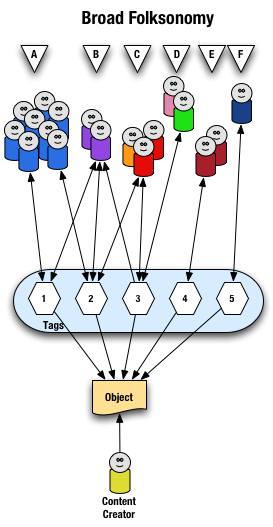
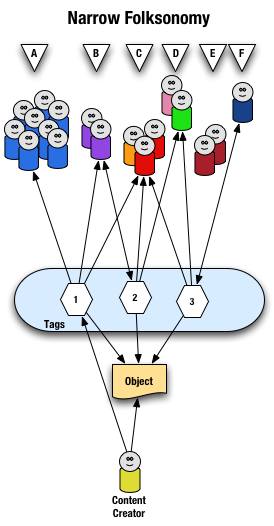
There have been many people who have correctly discerned a difference between the two prime folksonomy examples, Flickr and del.icio.us. As I first stated in a comment to Clay Shirky's first article on Folksonomy, there are two derivations of folksonomy. There is a narrow folksonomy and a broad folksonomy. On August 26th I stated...

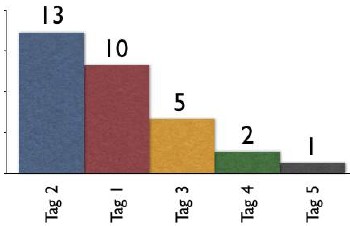
Clay, you bring in some very good points, particularly with the semantic differences of the terms film, movie, and cinema, which defy normalization. A broad folksonomy, like del.icio.us, allows for many layers of tagging. These many layers develop patterns of consistency (whether they are right or wrong in a professional's view is another matter, but that is what "the people" are calling things). These patterns eventually develop quasi power law for around the folk understanding of the terms as they relate to items.

Combining the power tags of "skateboarding, tricks, movie " (as you point out) will get to the desired information. The hard work of building a hierarchy is not truly essential, but a good tool that provides ease of use to tie the semantic tags is increasingly essential. This is a nascent example of a semantic web. What is really nice is the ability to use not only the power tags, but also the meta-noise (the tags that are not dominant, but add semantic understanding within a community). In the skateboarding example a meta-noise tag could be gnarly that has resonance in the skate community and adds another layer of refinement for them.

The narrow-folksonomy, where one or few users supply the tags for information, such as Flickr, does not supply power tags as easily. One or few people tagging one relatively narrowly distributed item makes normalizing more difficult to employ an tool that aggregates terms. This situation seems to require a tool up front that prompts the individuals creating the tags to add other, possibly, related tags to enhance the findability of the item. This could be a tool that pops up as the user is entering their tags that asks, "I see you entered mac do you want to add fruit, computer, artist, raincoat, macintosh, apple, friend, designer, hamburger, cosmetics, retail, daddy tag(s)?"

This same distinction is brought up on IAWiki' Folksonomy entry.

Since this time Flickr has added the ability for friends and family (and possibly contacts) to add tags, which gives Flickr a broader folksonomy. But, the focus point is still one object that is being tagged, where as del.icio.us has many people tagging one object. The broad-folksonomy is where much of the social benefit can be derived as synonyms and cross-discipline and cross-cultural vocabularies can be discovered. Flickr has an advantage in providing the individual the means to tag objects, which makes it easier for the object to get found.

This brings to the forefront the questions about Google's Gmail, which allows one person the ability to freely tag their e-mail entries. Is Gmail using a folksonomy? Since Gmail was included in the grouping of on-line tools that were in the discussion of what to call these things (along with Flickr and del.icio.us) when folksonomy was coined I say yes. But, my belief that Gmail uses a folksonomy (regular people's categorization through tagging) relates to it using the same means of one person adding tags so that object can be found by them. This is identical to how people tag in Flickr (as proven by the self-referential "me" that is ever prevalent) and del.icio.us. People tag in their own vocabulary for their own retrieval, but they also will tag for social context as well, such as Flickr's "MacWorld" tags. In this case Wikipedia is a little wrong and needs improving.

I suppose Gmail would be a personal folksonomy to the Flickr narrow folksonomy and the del.icio.us broad folksonomy. There are distinct futures for all three folkonomies to grow. Gmail is just the beginning of personal tagging of digital objects (and physical objects tagged with digital information). Lou Rosenfeld hit the nail on the head when he stated, "I'm not certain that the product of folksonomy development will have much long term value on their own, I'll bet dollars to donuts that the process of introducing a broader public to the act of developing and applying metadata will be incredibly invaluable.". These tools, including Gmail, are training for understanding metadata. People will learn new skills if they have a perceived greater value (this is why millions of people learned Palm's Graffiti as they found a benefit in learning the script).

Everybody has immense trouble finding information in their hierarchal folders on their hard drive. Documents and digital objects have more than one meaning than the one folder/directory, in which they reside. Sure there are short cuts, but tracking down and maintaining shortcuts is insanely awkward. Tags will be the step to the next generation of personal information managment.


26 December 2004

Flickr and the Future of the Internet

Peter's post on Flickr Wondering triggers some thoughts that have been gelling for a while, not only about what is good about Flickr, but what is missing on the internet as we try to move forward to mobile use, building for the Personal InfoCloud (allowing the user to better keep information the like attracted to them and find related information), and embracing Ubicomp. What follows is my response to Peter's posting, which I posted here so I could keep better track of it. E-mail feedback is welcome. Enjoy...

You seemed to have hit on the right blend of ideas to bring together. It is Lane's picture component and it is Nadav's integration of play. Flickr is a wonderfully written interactive tool that adds to photo managing and photo sharing in ways that are very easy and seemingly intuitive. The navigations is wonderful (although there are a few tweak that could put it over the top) and the integration of presentational elements (HTML and Flash) is probably the best on the web as they really seem to be the first to understand how to use which tools for what each does best. This leads to an interface that seems quick and responsive and works wonderfully in the hands of many. It does not function perfectly across platforms, yet, but using the open API it is completely possible that it can and will be done in short order. Imagine pulling your favorites or your own gallery onto your mobile device to show to others or just entertain yourself.

Flickr not only has done this phenomenally well, but may have tipped the scales in a couple of areas that are important for the web to move forward. One area is an easy tool to extract a person's vocabulary for what they call things. The other is a social network that makes sense.

First, the easy tool for people to add metadata in their own vocabulary for objects. One of the hinderances of digital environments is the lack of tools to find objects that do not contain words the people seeking them need to make the connection to that object they are desiring. Photos, movies, and audio files have no or limited inherent properties for text searching nor associated metadata. Flickr provides a tool that does this easily, but more importantly shows the importance of the addition of metadata as part of the benefit of the product, which seems to provide incentive to add metadata. Flickr is not the first to go down this path, but it does it in a manner that is light years ahead of nearly all that came before it. The only tools that have come close is HTML and Hyperlinks pointing to these objects, which is not as easy nor intuitive for normal folks as is Flickr. The web moving forward needs to leverage metadata tools that add text addressable means of finding objects.

Second, is the social network. This is a secondary draw to Flickr for many, but it is one that really seems to keep people coming back. It has a high level of attraction for people. Part of this is Flickr actually has a stated reason for being (web-based photo sharing and photo organizing tool), which few of the other social network tools really have (other than Amazon's shared Wish Lists and Linkedin). Flickr has modern life need solved with the ability to store, manage, access, and selectively share ones digital assets (there are many life needs and very few products aim to provide a solution for these life needs or aims to provide such ease of use). The social network component is extremely valuable. I am not sure that Flickr is the best, nor are they the first, but they have made it an easy added value.

Why is social network important? Helping to reduct the coming stench of information that is resultant of the over abundance of information in our digital flow. Sifting through the voluminous seas of bytes needs tools that provide some sorting using predictive methods. Amazon's ratings and that matching to other's similar patterns as well as those we claim as our friends, family, mentors, etc. will be very important in helping tools predict which information gets our initial attention.

As physical space gets annotated with digital layers we will need some means of quickly sorting through the pile of bytes at the location to get a handful that we can skim through. What better tool than one that leverages our social networks. These networks much get much better than they are currently, possibly using broader categories or tags for our personal relationships as well as means of better ranking extended relationships of others as with some people we consider friends we do not have to go far in their group of friends before we run into those who we really do not want to consider relevant in our life structures.

Flickr is showing itself to be a popular tool that has the right elements in place and the right elements done well (or at least well enough) to begin to show the way through the next steps of the web. Flickr is well designed on many levels and hopefully will not only reap the rewards, but also provide inspiration to guide more web-based tools to start getting things right.


27 May 2004

Dodgeball

I am intrigued with Dodgeball (location-based social software for mobile devices). Were I not home or at work most of my waking hours I would think this is a great tool. It is definitely one to watch as it could be helpful when I am out and about and can meet up with others and kill two birds (so to speak).


11 April 2004

Stitching our Lives Together

Not long ago Jeffrey Veen posted about Will you be my friend, which brought up some needs to better stitch together our own disperse information. An excellent example is:

For example, when I plan a trip, I try to find out who else will be around so I have people to hang out with. So my calendar should ask Upcoming.org, "Hey, Jeff says he's friends with Tim. Will he be in New York for GEL?"

This example would allow up to interact with our shared information in a manner that keeps it within our extended Personal InfoCloud (the Personal InfoCloud is the information we keep with us, is self-organized, and we have easy access to). Too many of the Web's resources where we store our information and that information's correlation to ourselves (Upcoming.org, LinkedIn, etc.) do not allow interactivity between online services. Some, like Upcoming and Hilton Hotels do provide standard calendaring downloads of the events and reservations you would like to track.

Some of this could be done with Web Services, were their standards for the interaction. Others require a common API, like a weblogging interface such as Flickr seems to use. The advent of wide usage of RSS feeds and RSS aggregators is really putting the user back in control of the information they would like to track. Too many sites have moved toward the portal model and failed (there are large volumes of accounts of failed portal attempts, where the sites should provide a feed of their information as it is a limited quantity). When users get asked about their lack of interest in a company's new portal they nearly always state, "I already have a portal where I aggregate my information". Most often these portals are ones like My Yahoo, MSN, or AOL. Many users state they have tried keeping more than one portal, but find they loose information very quickly and they can not remember, which portal holds what information.

It seems the companies that sell portal tools should rather focus on integration with existing portals. Currently Yahoo offers the an RSS feed aggregator. Yahoo is moving toward a one stop shopping for information for individuals. Yahoo also synchs with PDA, which is how many people keep their needed information close to themselves.

There are also those of us that prefer to be our own aggregators to information. We choose to structure our large volumes of information and the means to access that information. The down side of the person controlling the information is the lack of common APIs and accessible Web Services to permit the connecting of Upcoming to our calendar (it can already do this), with lists of known or stated friends and their interests.

This has been the dream of many of us for many years, but it always seems just around the corner. Now seems to be a good time to just make it happen. Now is good because there is growing adoption of standards and information that can be personally aggregated. Now is good because there are more and more services allowing us to categorize various bits of information about our lives. Now is good because we have the technology. Now is good because we are smart enough to make it happen.


19 March 2004

SixApart's TypeKey Coming Soon

SixApart's TypeKey looks to be a good resource to help authenticate those making comments on Web sites. I have been very happy with SixApart's TypePad, not that I am ready to move off my own system. Actually it sounds like TypeKey will have an open API that will allow those who have built their own weblogging tools to take advantage of the authentication services. This is one feature that has been on my own drawing board, but now I will be waiting for SixApart.


30 December 2003

Matt on Social Networks

Matt writes up this thoughts on the state of social networks. I agree with much of his frustration. I keep thinking many of these tools will provide some good value. The two that meet what I expect are Upcoming and LinkedIn. I like these are they offer small targeted offerings. Upcoming helps find and track events, while LinkedIn is a work related networking tool.

It seems a simple cross between LinkedIn and XFN or any metadata resource that can track relationships, trust, and taste along with tracking other items of interest would be greatly helpful. Matt does get the metadata problem included in his write-up, which is metadata is dirty and at best, biased (which can be good if you agree with the bias).


14 December 2003

Amazon Wishlist is My Favorite Social Network

With the all the buzzing about Friendster and other "social network" site, I have lost nearly all of the interest I have had in most of them. I still have a couple that picque my interest, but the seeming most popular, Friendster, offers me nothing. There is one tool social networking tool that has never let me down and actually provides me a great service.

What is my favorite social networking tool? Amazon's Wishlist. I am always looking for new media (books, music, DVDs, periodicals, etc.) and I kept hoping Friendster and other social networks would do this I was let down. I kept wishing the seemingly simple tools Amzon provides would be incorporated by others.

One every month or two I cruise through my Wishlist, which I use from my Hiptop when I go to any book or music store to either add to my list or verify an items in front of me is actually the one I want. I also cruise it from a computer to remind myself of items of interest or delete them. I also browse those Wishlists I link to. I find gems I did not know about in others lists. I also have redeemed coupons from my Amazon Wishlist friends and forwarded to me when they make purchases. I was feeling bad when I forgot to click the send a link to a discount to your Amazon friends so that the messages would not be sent. I have been finding those I link to have been happy to receive the discounts and have actually used them. The e-mails have also promted e-mail conversations with friends I have not talked to in a while. This goes a long way toward a very good social network in my book.


Research Lab for Human Connectedness

The Media Lab Europe's research lab for Human Connectedness really has some great things in progress. The most news worthy of late has been tunA, which is a wireless sharing of your personal music device, which extends your personal info cloud and creates a local info cloud for others. tunA was covered in Wired News: Users Fish for Music article a couple weeks ago.

The group's focus tends to be connecting people by digital tools using aural and visual presentation methods. There are some very intriguing applications that could come out of this research.


17 November 2003

More on Urban Tapestries

More on Urban Tapestries:

Urban Tapestries is a framework for understanding the social, cultural, economic and political implications of pervasive location-based mobile and wireless systems. To investigate these issues, we are building an experimental location-based wireless platform to allow users to access and author location-specific content (text, audio, pictures and movies). It is a forum for exploring and sharing experience and knowledge, for leaving and annotating ephemeral traces of peoplesí presence in the geography of the city.


3 June 2003

Social computing needs more than chat

I was awake at an hour only God, ravers, and vampires would love this morning and stumbled across Bill Thompson's BBC article about social computing needing to be more than chat. I went to bed after I read this then thought I may have dreamt the article, and did not know where I had read it. The article brings the recent hype about social software down to earth as it was and has been a discussion point in many things Internet since the late 1980s and early 1990s. Bill does suggest we may have evolved enough to discuss the social changes that are brought about in a digitally networked world without discussion of packets and protocols.

This article also jumps into the attention ideas get when published in a weblog as compared to an academic research paper. Bill's perspective is the lack of research into what has been discovered and written about previously is detrimental to social software and networking moving forward. This resonates with those who have liberal education backgrounds that have been taught to seek out the fountainhead of an idea and find what others have communicated so to build upon experiences rather than offer up a "me too" or a "that was my idea" (20 years or centuries after it was common thought).


16 March 2003

Social Networks with InFlow

Steven Johnson examines Vladis Krebs' InFlow software to find social networks. This is a visualization tool that draws the lines that make up the connections in our lives and interactions. More about InFlow and information about Krebs will help you under social networking from an automated perspective.

Graphviz provides similar (yet simpler) output.


This work is licensed under the Creative Commons Attribution-NonCommercial-ShareAlike License.